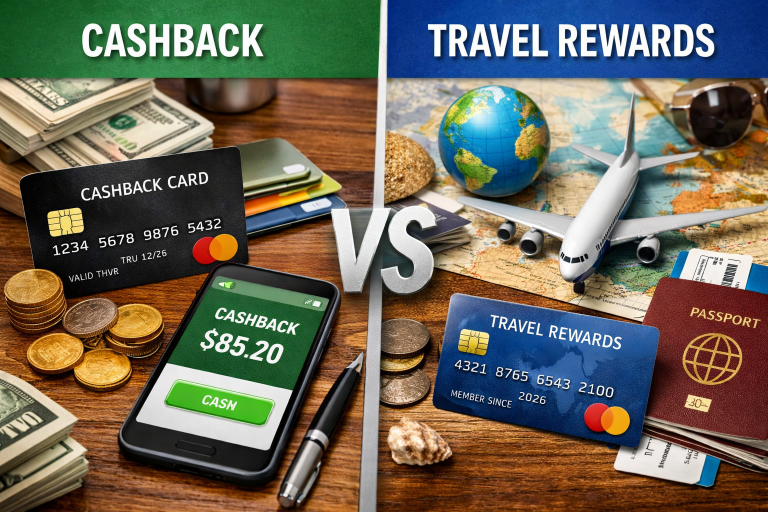
Cashback vs Travel Rewards Credit Cards: Which One Saves You More Money in 2026?

When facing unexpected expenses or planning a large purchase, many people struggle to decide between using a credit card or taking out a personal loan. Both options offer access to funds, but they differ significantly in cost, repayment structure, and long-term financial impact. Understanding these differences is essential to choosing the most affordable solution.
This article compares personal loans vs credit cards to help you determine which option is cheaper based on interest rates, fees, repayment terms, and real-life use cases.
A personal loan provides a lump sum of money that is repaid over a fixed period with scheduled monthly payments. Most personal loans come with fixed interest rates, which means your payment amount stays the same throughout the loan term.
Key cost components of a personal loan include:
Because personal loans have defined repayment schedules, borrowers know exactly how much they will pay over time. This predictability often makes them more affordable for large expenses such as debt consolidation, medical bills, or home improvements.
In many cases, personal loans offer lower interest rates than credit cards, especially for borrowers with fair to good credit.
Credit cards provide a revolving line of credit, allowing you to borrow repeatedly up to a set limit. While they offer flexibility and convenience, they often come with higher interest rates.
Typical credit card costs include:
Unlike personal loans, credit cards do not have fixed repayment timelines. Making only the minimum payment can result in paying interest for years, significantly increasing the total cost of borrowing.
Credit cards are generally more expensive when carrying balances long-term, especially for large purchases.
Interest rates are the biggest factor when comparing borrowing costs.
Personal loans typically offer:
Credit cards typically offer:
For borrowers who plan to repay over several months or years, personal loans are usually cheaper due to their lower interest rates. Credit cards may be cost-effective only if the balance is paid in full every month or during a 0% APR promotional period.
Failing to pay off a credit card balance quickly can make it one of the most expensive borrowing options available.
Beyond interest rates, fees and repayment structures play a major role in overall cost.
Personal loans:
Credit cards:
The structured nature of personal loans encourages disciplined repayment, reducing the risk of accumulating long-term debt. Credit cards, while flexible, can lead to overspending and prolonged balances if not managed carefully.
For budgeting and financial planning, personal loans often provide greater control and transparency.
The cheaper option depends largely on how you plan to use the funds.
Personal loans are usually cheaper when:
Credit cards may be cheaper when:
If you can commit to paying off your credit card balance quickly, the cost may be minimal. However, for long-term borrowing, personal loans almost always result in lower total interest paid.
Choosing between a personal loan and a credit card requires evaluating your financial habits and goals.
Ask yourself:
Borrowers who prefer structure and lower interest costs often benefit more from personal loans. Those who value flexibility and short-term borrowing may find credit cards more suitable.
Making an informed decision can save hundreds—or even thousands—of dollars over time.
So, which is cheaper: a personal loan or a credit card?
In most long-term scenarios, personal loans are the more affordable option due to lower interest rates and structured repayment. Credit cards can be cost-effective only when balances are paid off quickly.
Understanding the true cost of borrowing empowers you to make smarter financial choices. Whether you choose a personal loan or a credit card, responsible usage and timely payments are the keys to minimizing costs and protecting your financial health.